INTRODUCTION
Frank Drake was a radio astronomer who was very interested in the search for extraterrestrial intelligence and conducted the first radio search of extraterrestrial signals in 1960. The project to do this was called project Ozma and it used an 85 foot (26 metres) diameter radio telescope at the National Radio Observatory at Greenback in West Virginia, USA. Two stars were targeted, Tau Ceti and Epsilon Eridani.
Frank Drake is also known for the "Drake Equation" which he devised to try and estimate the number of civilisations in the Milky Way galaxy which possess the ability to communicate over interstellar distances.
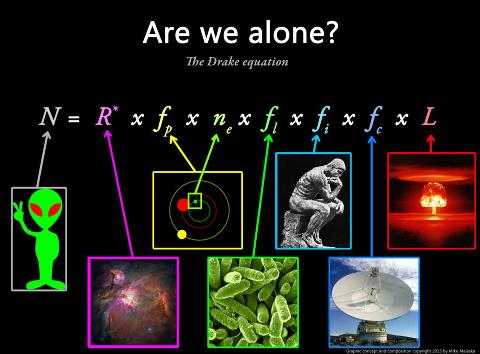
THE DRAKE EQUATION
N is the number of communicating civilisations in the galaxy
R* is the rate of star formation
fp is the fraction of stars that have planets
ne is the number of planets that might sustain life
fl is the fraction of such planets where life might be present
fi is the fraction of those where intelligence might be present
fc is the fraction of those that might have developed interstellar communication
L is the lifetime of such civilisations
The first three factors are astronomical in nature
The next two are biological
The last two are social in nature
We now know the astronomical factors within a few orders of magnitude.
We have essentially no knowledge of either the biological or social factors. Different people have vastly different ideas about these factors, and when these are inserted into the equation we get values of N from essentially zero to a billion or so.
Because of this most people have concluded that the Drake equation is not much use in determining the value of N. However it may be more useful used in the reverse sense.
That is, because a large number of radio searches for ETI have produced null results (Paul Davies calls this the ‘Eerie Silence’), we can say with some certainty that the biological and/or social factors are very low and that ETI is probably very rare in the galaxy.
 Australian Space Academy