OVERVIEW
An exoplanet (or extrasolar planet) is a planet that exists outside our solar system. Although the existence of exoplanets has been speculated for a long time the first confirmed detection of an exoplanet occurred in 1992.
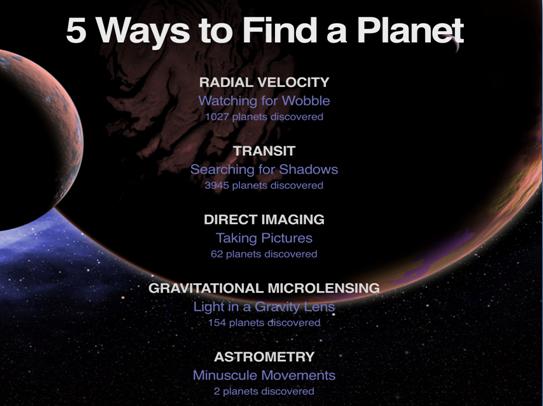
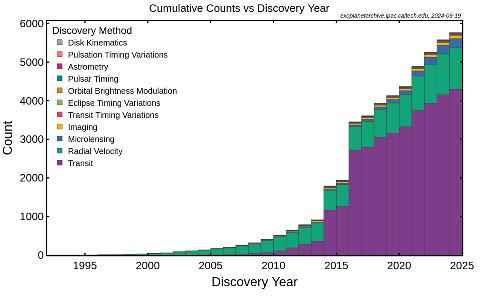
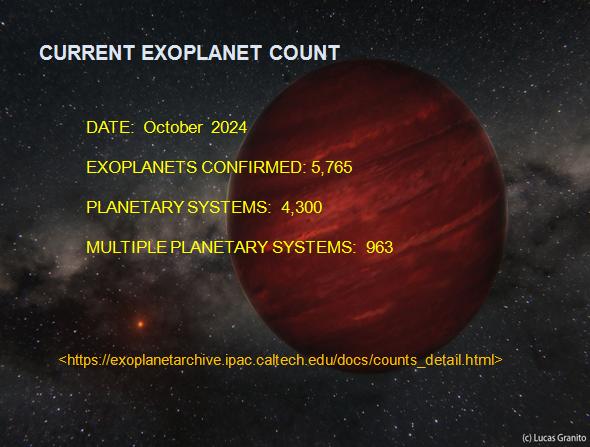
There are now (2024) over 5000 exoplanets that have been confirmed. Exoplanets may be detected by several methods but by far the largest number of detections have been by the radial velocity technique of measuring the periodic movement of the host star by its Doppler shift, and the transit photometry of the host star to measure the decrease in light intensity when the planet moves in front of the star.
A wide variety of stars with diverse masses and orbits have been detected and classified according to their mass and orbital period/radius. In some cases other astronomical observations have been able to determine other properties of the planet including atmospheric composition.
Rogue planets, which move through space without a host star nearby have now been discovered.
HISTORY
We know that speculations of planets around other stars have been made for hundreds if not thousands of years. Giordano Bruno was one of the first to record his speculations on this matter in the late 1500’s. Isaac Newton later agreed with the concept. By the late 1800’s some astronomers started to claim that they had found evidence of such planets through anomalous motions detected in various stars.
It is thought that the first real evidence of an exoplanet may have been found in 1917 when astronomers detected heavy elements in the spectra of a white dwarf star (Van Maanen 2). Later (2016) re-examination showed these elements could not have come from the star but from an orbiting planet, but so far no planet has been found. In 1988 changes in the movement of the star Gamma Cephei were attributed to an unseen orbiting planet but it wasn't confirmed until 2002.
The first actual detection of exoplanets was made in 1992 of two planets about a pulsar. This was made using radio astronomical timing measurements of the pulsar. The first detection of a planet about a solar type star was made in 1995 by two Swiss astronomers. Since then over 5800 exoplanets have been found and confirmed (2024).
HOW TO FIND AN EXOPLANET
THE TRANSIT METHOD
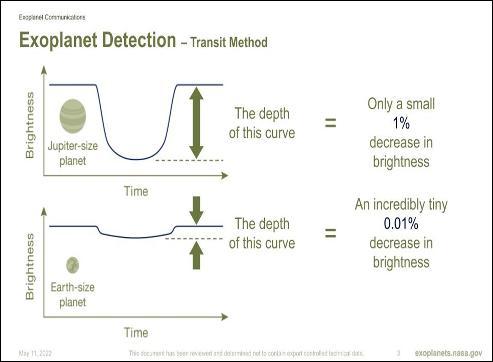
The largest number of confirmed exoplanets have been discovered by the transit method. This may be used by ground or space observatories. However atmospheric scintillations limit ground detections to the larger exoplanets. The transit method of detection produces a diameter (or radius) estimate for the size of the planet.
 | 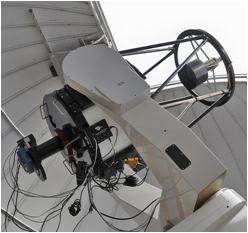
Mexico desert used to detect exoplanets via the transit method. |
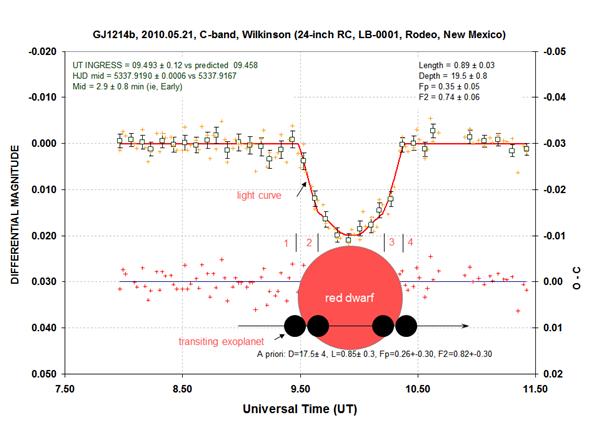
This transit was recorded using the telescope in New Mexico shown above.
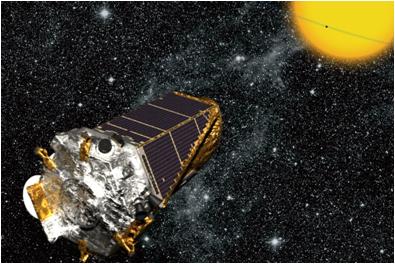
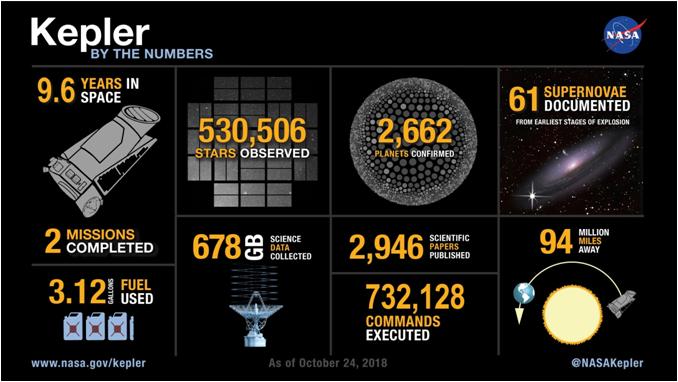
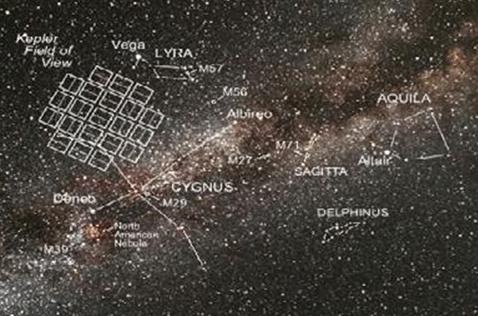
The Kepler spacecraft, which orbits the Sun behind the Earth has found the largest number of exoplanets than any other single telescope so far. The image below shows the first Kepler field (K1) that was examined out to a distance of 3,000 light years. A second field (K2) was also examined. K2 was to the right and above K1 in the image. Both fields were close to the main density of stars and dust visible in the Milky way but displaced to the north to avoid the higher density star fields closer to the galactic centre.
THE RADIAL VELOCITY METHOD
The planet and the star orbit around their common centre of gravity. It is the motion of the star that is measured by the Doppler shift of spectral lines in the stellar atmosphere. The mass of the planet is calculated from the stellar mass.
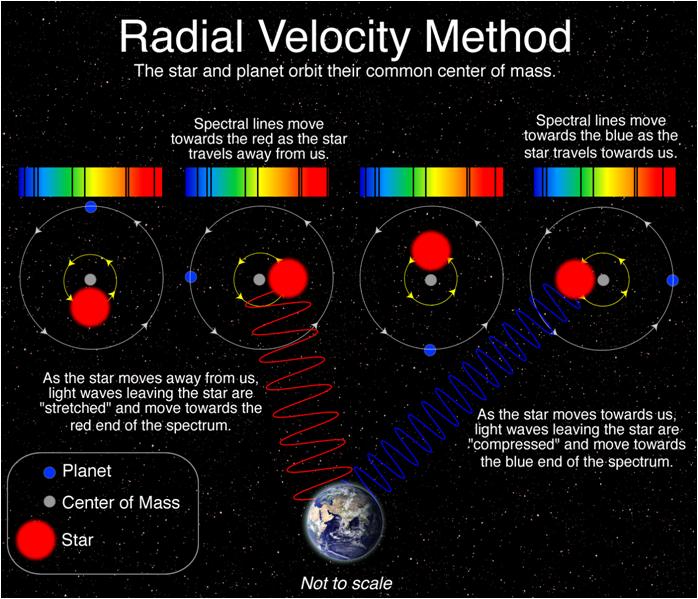
Radial velocity is the best method for finding big planets in close orbit around their star, for finding the mass of exoplanets and to use with ground-based telescopes. It is not good for finding planets in distant orbits, for measuring exoplanet diameters or for finding small exoplanets. All this explains why the first exoplanets found were in the majority “hot Jupiters”, that is large planets close to the Sun.
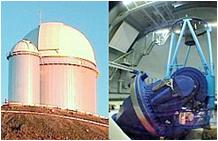 and the HARPS spectrograph used to find exoplanets from their Doppler Shift (RVM) | 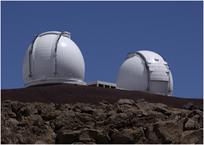
hosts the MOSFIRE & HIRES spectrographs for RV exoplanet work. |
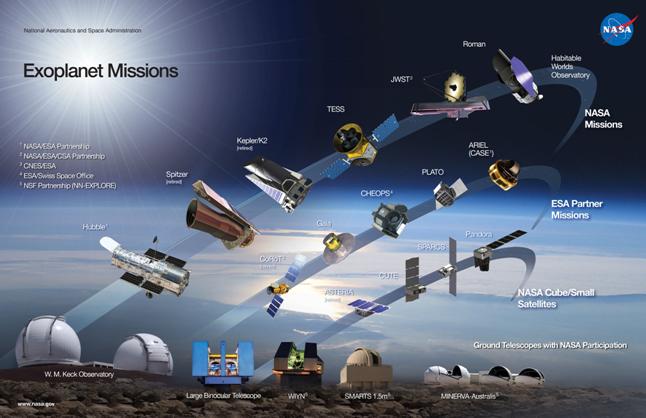
SEARCH INSTRUMENTS
CLASSIFICATION OF EXOPLANETS
The classification of exoplanets is still a work in progress, as new discoveries continuously reshape our understanding of these distant worlds. And future observations and missions, such as those being undertaken by TESS and the James Webb Space Telescope, will provide even more detailed information about exoplanets’ atmospheres, compositions, and potential habitability.
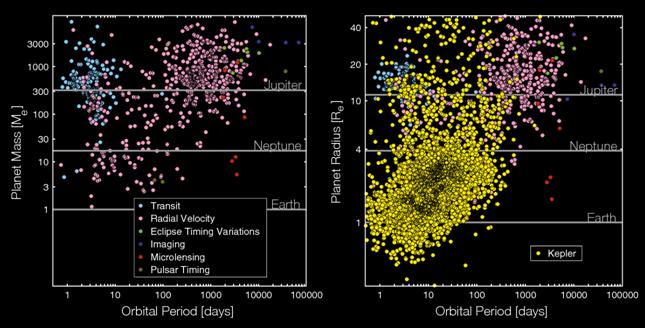
Classification could be based upon many parameters, but only a few may be determinable for each entry. Possible classification parameters might include:
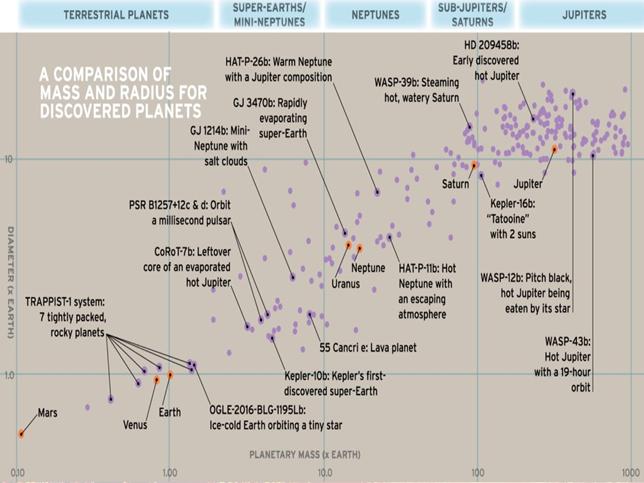
CALCULATION OF EXOPLANET PARAMETERS
If the diameter d of an exoplanet is known from the transit method then its radius r and volume V can be calculated from:
V = 4/3 π r3 ≈ 4 r3
The radial velocity method (Doppler shift) then allows us to determine the mass m of the planet given the mass M and orbital radius R of the planet.
Given the planet mass and volume we can then determine the planet density:
The stellar flux F at the planet = L / (4 π R2 ) where L ∝ T4 is the stellar luminosity.
EXOPLANET TEMPERATURE
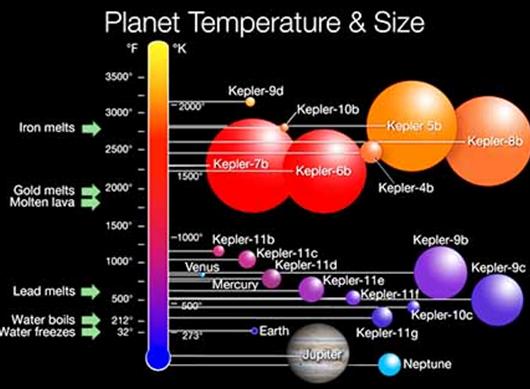
The temperature of an exoplanet is basically a classification of its distance from the star it orbits.
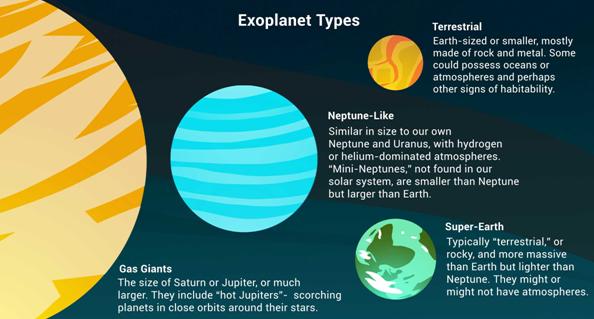
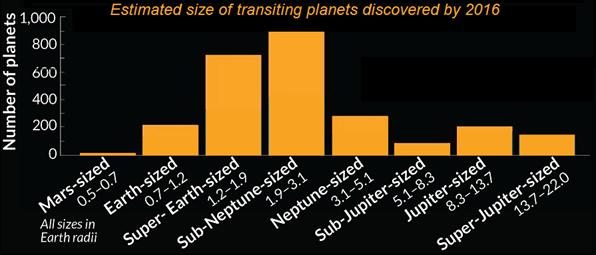
EXOPLANET TYPES
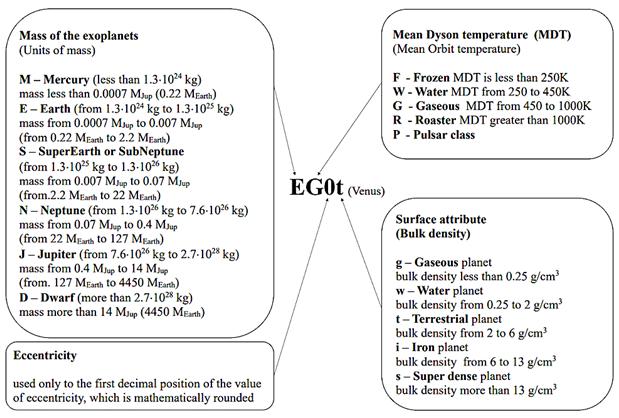
A DETAILED CLASSIFICATION
This suggestion is based on Mass, Orbit, Temp, Density. Whether a classification of a planet should be based on orbit is questionable as planets are believed to 'migrate' into different orbits for a number of reasons, collisions being the most frequent.
PULSAR EXOPLANETS
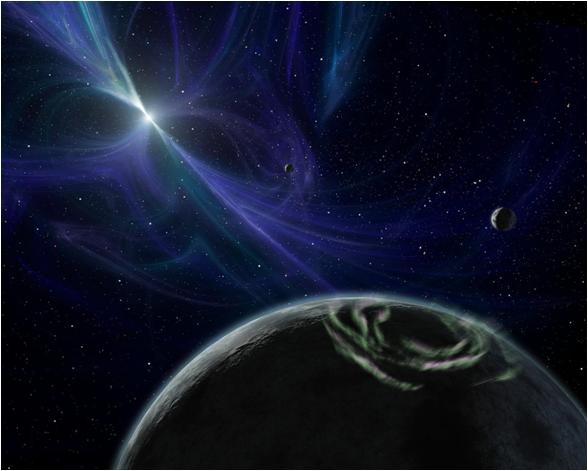
The first exoplanets were discovered orbiting around a pulsar in 1992. The system was around PSR B1257+12. This was detected by timing variations in the pulsar rotation rate.
This discovery was very unexpected because a pulsar is a rotating neutron star that has formed in an extremely explosive process at the end of life of a massive star. Such a process was thought to have destroyed any trace of previously orbiting planets. However, this pulsar is a millisecond pulsar which is thought to have been ‘spun-up’ due to the accretion of mass from an adjacent star. Note the aurorae on the planet due to the large stellar wind expected from the pulsar.
THE FIRST CONFIRMED EXOPLANET
The first exoplanet confirmed discovery was 51 Pegasi b, discovered in 1995. It is also named Dimidium.
Dimidium orbits the main sequence star 51 Pegasi which is similar to the Sun, and is located in the constellation Pegasus 50 light years from Earth. The orbit of Dimidium is so close to its star that it grazes its outer atmosphere. This type of planet is sometimes referred to as a ‘roaster’. The planet is classified as a “Hot Jupiter” and has an estimated surface temperature between 540 and 980 C. It orbits around its star in 4 days.
The discovery was made by the Swiss astronomers Didier Queloz and Michel Mayor using the radial velocity method to detect the small wobble in 51 Pegasi
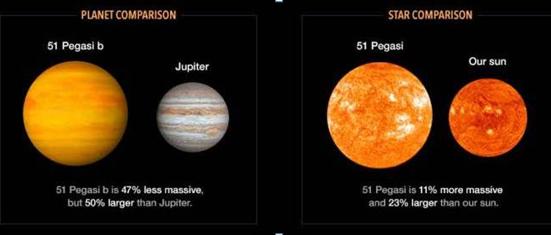
A comparison of the sizes of the star 51 Pegasi and the planet 51 Pegasi b is shown below.
THE TRAPPIST-1 SYSTEM EXOPLANETS
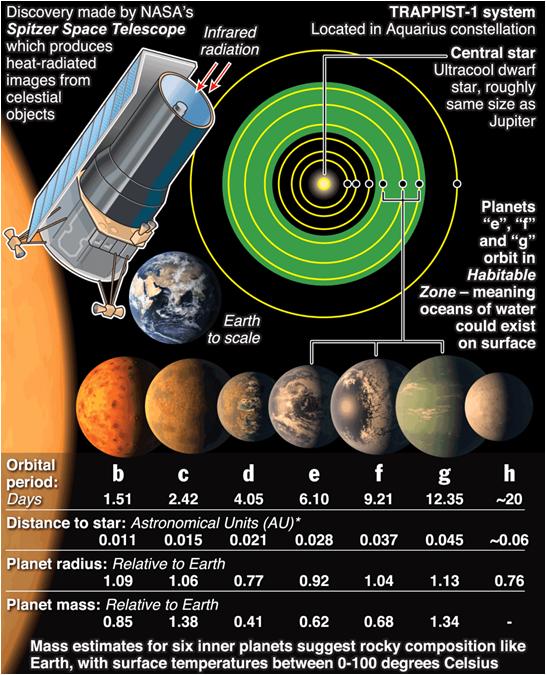
The star Trappist-1 is located 40 light years from Earth in the constellation of Aquarius. The Spitzer Infrared Space Telescope discovered a system of seven Earth sized exoplanets orbiting around this star in 2016. Many other telescopes have studied the this system. The name of the star comes from the telescope that first observed it - 'Transiting Planets and Planetesimals Small Telescope', located at La Silla Observatory in Chile.
Three of the planets lie within the Goldilocks zone and mass estimates for the 6 inner planets have a rocky composition like the Earth.
The central star is a very ‘cool’ small star only about the size of Jupiter.
The planets e, f and g are the ones that orbit within the habitable zone where their surface temperatures are predicted to be between 0o C and 100o C.
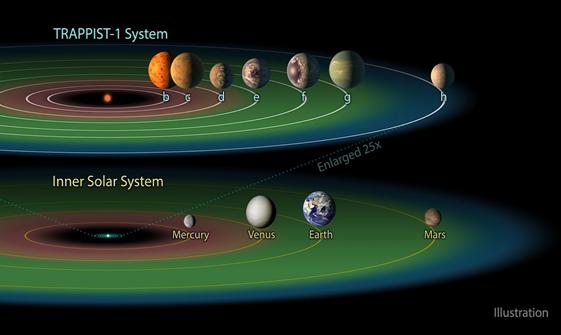
A comparison of the Trappist-1 system with the solar system is shown below>
A SUB_EARTH EXOPLANET AROUND BARNARD'S STAR
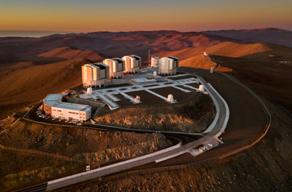
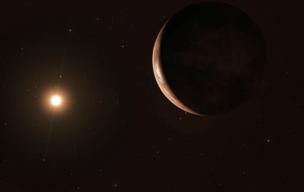
From 2018 the Very Large Telescope (VLT) in Chile was used to make observations of a rare sub-Earth sized planet orbiting Barnard’s star, 6 light years away and the second closest star to the Sun. Barnard b is 20 times closer to its star than Mercury is to the Sun. Barnard’s star is a red dwarf with a surface temperature of 3500o C.
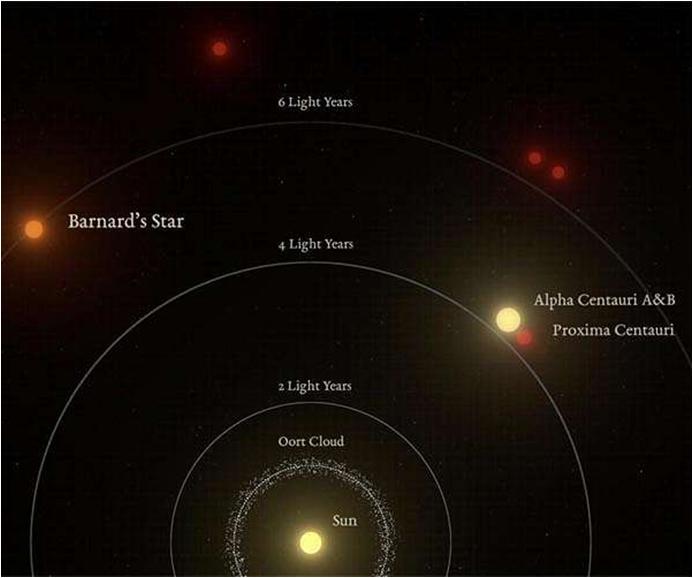
A year on the planet lasts just three Earth days, and its surface temperature is 125o C, taking it outside the traditional habitable zone. Barnard b is one of the lowest-mass exoplanets known and one of the few known with a mass less than that of Earth. Barnard's Star is located in the constellation Ophiuchus. After the three stars in the Alpha Centauri system, 4.2 light years away, it is the closest to our Sun. The researchers also found evidence of three other potential exoplanets orbiting Barnard's Star but need more observations to confirm their findings. This discovery, along with that of three exoplanets orbiting our nearest star Proxima Centauri makes a possible 6 low mass exoplanets in our neighbourhood. Only Proxima b is in the Goldilocks Zone.
 | 
|
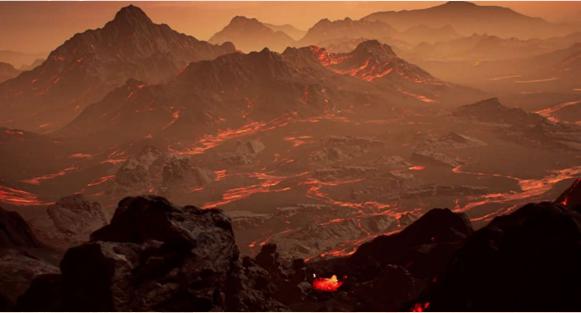
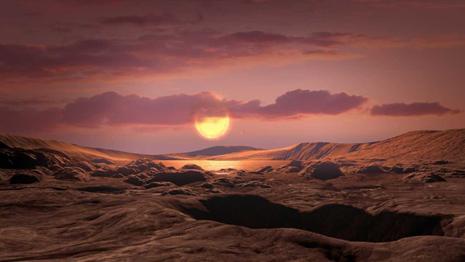
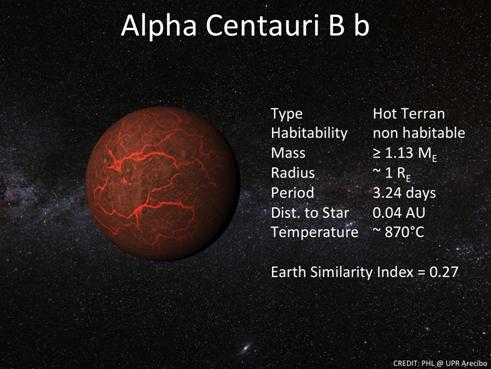
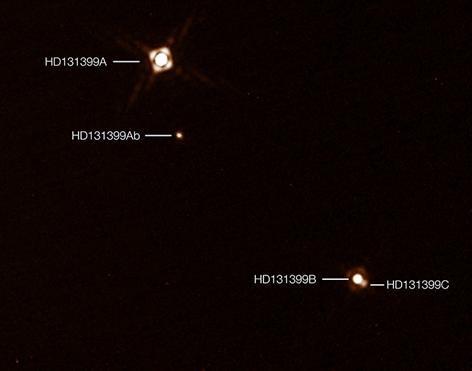
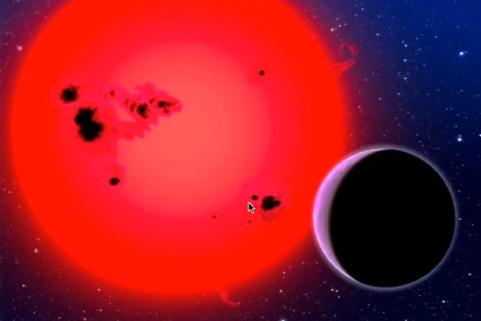
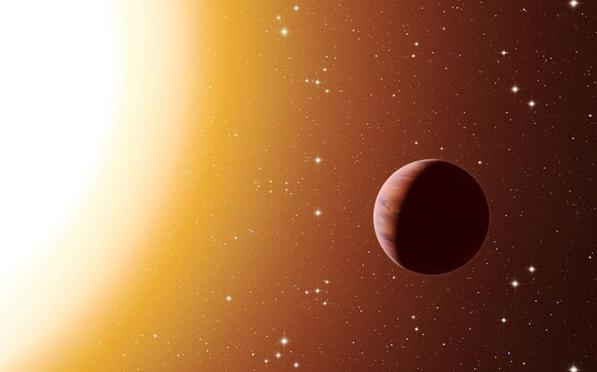
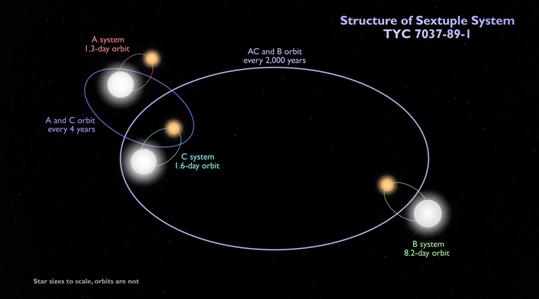
IMAGINED EXOPLANETS

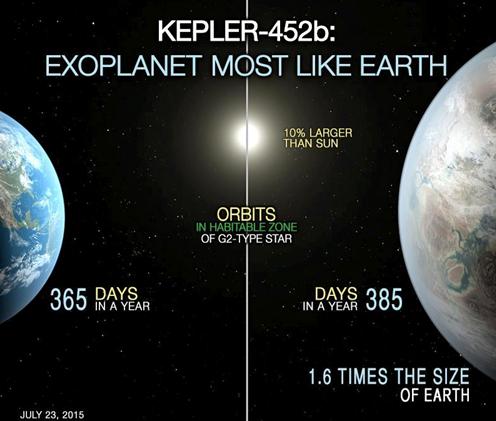
HABITIBILITY OF EXOPLANETS
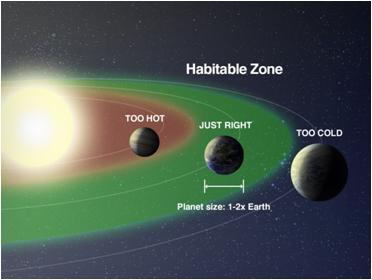
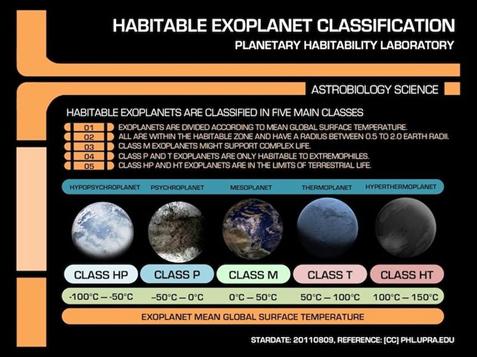
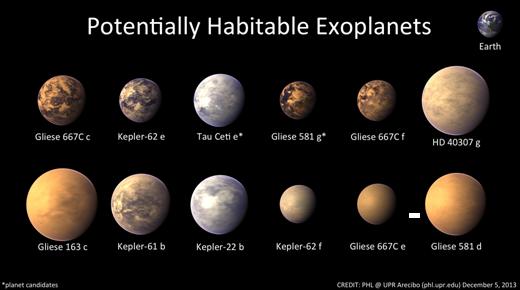
It is thought that one of the criteria for life on a planet around a star is that the planet must orbit in a zone called the habitable zone. This zone is the area around the star at which liquid water could exist on the planet’s surface. It is also known as the Goldilocks zone, where conditions might be just right - neither too hot nor too cold - for life. The minimum and maximum distances defining this zone will vary with the type of star an exoplanet orbits. However other factors may be important, such as the amount of lethal radiation a planet receives from the star it orbits. A planet must also be stable for many years.
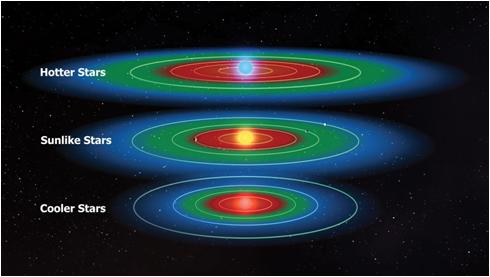
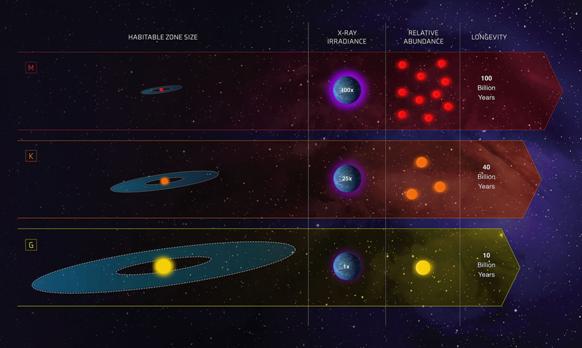
Larger stars have larger habitable zones and are thought to produce less lethal radiation, but their lifetime is less and they are relatively less abundant in the galaxy.
DETECTING EXOPLANET ATMOSPHERES
When the light from a star passes through a planetary atmosphere it absorbs different wavelengths of the light depending upon the gases that reside in the atmosphere.
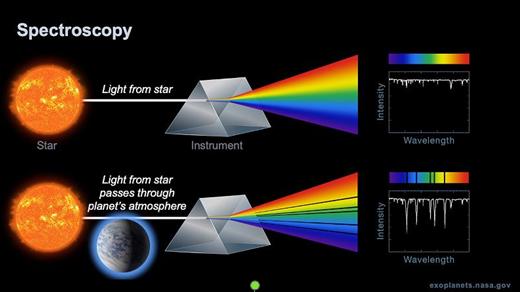
Atmospheres have been detected around several exoplanets. The first to be observed was HD 209458 b in 2001.
KIC 12557548 b is a small rocky planet, very close to its star, that is evaporating and leaving a trailing tail of cloud and dust like a comet. The dust could be ash erupting from volcanoes and escaping due to the small planet's low surface gravity, or it could be from metals that are vapourised by the high temperatures due to its close proximity to its star, with metal vapour then condensing into dust.
In June 2015 it was reported that the atmosphere of GJ436 b was evaporating, resulting in a giant cloud around the planet and a long trailing tail 14 million km long (due to radiation from the host star).
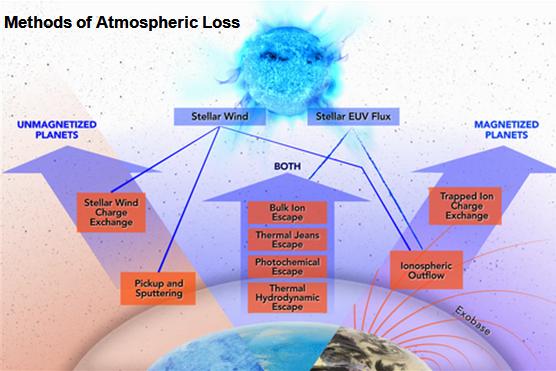
There are several mechanisms by which a planet may lose its atmosphere.
STAR TYPES HOSTING EXOPLANETS
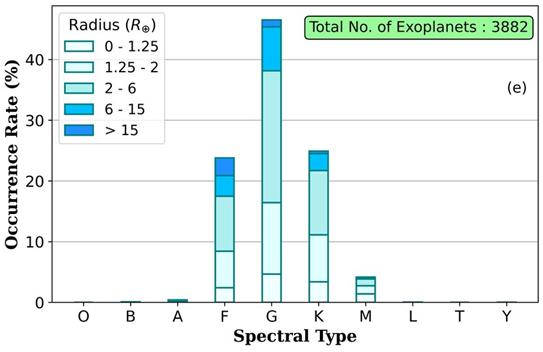
The star types so far found to host exoplanets are clustered around G type stars, the same type of star around which the Earth orbits.
STELLAR SYSTEMS - PLANET ORDERING
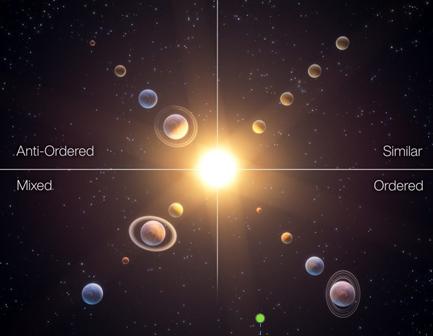
Approximately 1000 stars have been found that host multi-planetary systems (2024). For stellar systems with more than one exoplanet they have been classified in one of four ordering regimes as shown below.
FREE FLOATING PLANETS
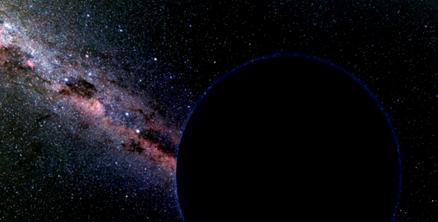
Free floating, Orphan or Rogue planets which do not orbit a star, have now been found. It is believed that such planets have either been ejected from a stellar system or possibly even formed in space outside such a system. Without the warmth of a star these planets are likely to be very cold and dark, with only internal heat to keep the surface above about 3 degrees K (the temperature of space). An Orphan planet would still be subject to galactic gravity and in the solar neighbourhood would be travelling at 250 km/s around the galactic centre. Some people think there may be billions of orphan planets in the galaxy.
EXOPLANET COUNT
REFERENCES
Michael Summers & James Trefil, “Exoplanets”, Smithsonian Books, 2017
Michael Perryman, “The Exoplanet Handbook”, Cambridge Press, 2018
Sara Seager, “Exoplanet Atmospheres”, Princeton University Press, 2011
Joshua N Winn, “The Little Book of Exoplanets”, Princeton University Press, 2023
THE SEARCH CONTINUES

 Australian Space Academy