 |
 |
SUMMARY
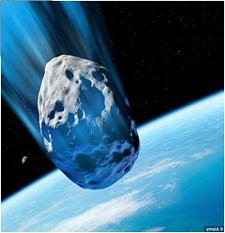
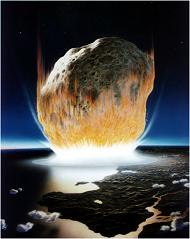
There is evidence that the Earth has been subject to bombardment by planetoids in the past with disastrous results.
The Earth will undoubtedly be subject to such bombardment in the future.
We are now at the stage of space technology where we are capable of diverting such a collision.
To pursue this capability we need to closely study the threat and the means by which it might be averted.
Planetary Defence is defined as that activity concerned with protecting the Earth and its inhabitants from destruction due to impact by a large piece of space debris such as an asteroid or a comet.
|
|
ORIGIN
The term "Planetary Defense" was coined by Lindley Johnson and promoted by Colonel Simon (Pete) Worden of the US Air Force Space Command 50th Space Wing. It was a term to indicate that we are under bombardment from outer space. Not an attack from an alien race, but a sporadic bombardment by naturally occurring objects in the solar system: asteroids and comets, fragmentary space debris, which occasionally are perturbed onto a collision course with Earth.
 |
 |
The term furthermore, is a recognition that our technology has now advanced to the point where not only can we search for and track such objects, but where we may also be in a position to deflect them from their intended path, and thus avert a disaster or catastrophe.
 |
 |
THE THREE PHASES OF PLANETARY DEFENCE
PHASE 1 - ACKNOWLEDGEMENT
The need to fully realise that there is a real threat and the magnitude of that threat.
PHASE 2 - ACQUISITION
A survey of all planetoids/asteroids to compute accurate orbits and evaluate which are threats to the Earth.
PHASE 3 - AVERSION
Evaluation of space technology to assess the assets required for diversion of the threat.
PLANETARY DEFENCE - PHASE 1
ACKNOWLEDGEMENT AND AWARENESS
The first phase of planetary defence is an awareness and an acknowledgement that the Earth has been subject to a cosmic impact hazard in the past, and will be the target of hypervelocity impacts from comets and asteroids in the future.
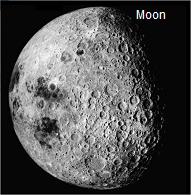
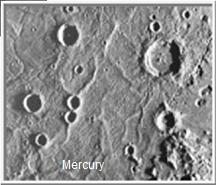
Evidence comes from astronomy which shows us the cratered state of other bodies in the solar system, from geology which has found craters on the Earth and explains their limited number in active processes, from paleontology which provides proof of species mass extinctions, and from physics which can extrapolate orbits and calculate damage.
 |
 |
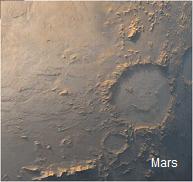 |
Historical evidence comes from our knowledge of the solar system. Everywhere we look we find craters - on planets, on moons and on asteroids. Only on the giant planets do we not find craters, and that is because Jupiter, Saturn, Uranus and Neptune do not have solid surfaces - only gaseous atmospheres which extend deep into the planet.
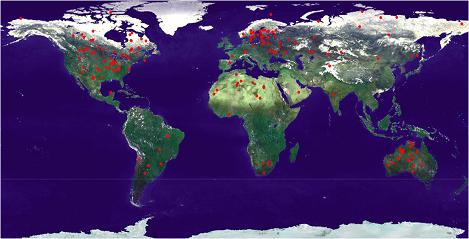
Even on the Earth we find evidence of craters. These are not as prolific as elsewhere, but that is because the Earth is geologically and meteorologically active and these processes destroy the evidence of craters after a time.
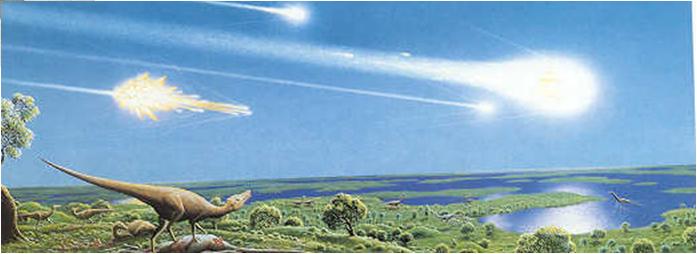
We also have the paleontological evidence of mass extinctions.
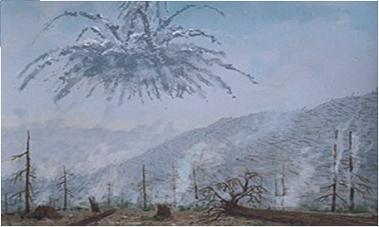
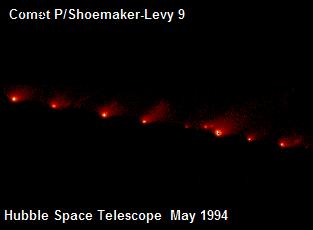
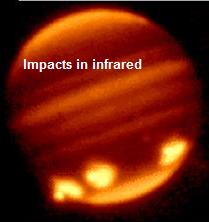
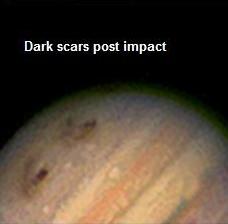
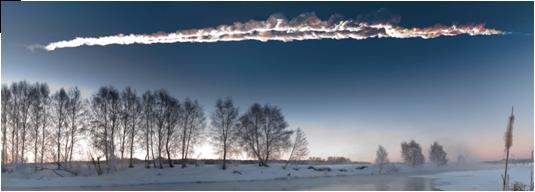
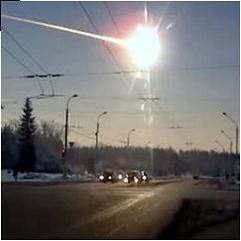
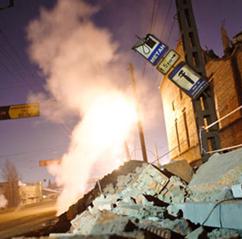
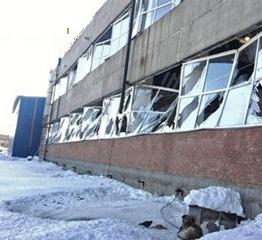
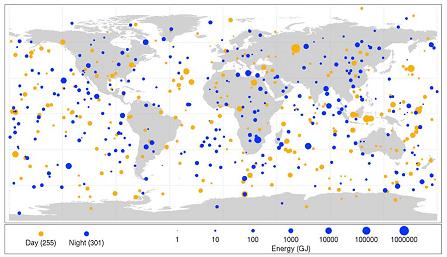
Even recent history has given us evidence of collision events:
 |
 |
 |
PHYSICS - IMPACT EFFECTS
The energy released in an NEO impact is essentially the kinetic energy of the NEO.
At hypervelocities (>4 km/sec) a body has an energy in excess of the explosive energy that would be released by the same mass of chemical explosive (eg TNT).
The velocities actually encountered in Earth impacts range from 11 to 72 km/sec. The lower limit is due to the Earth's gravitational attraction (and is equal to the Earth's escape velocity).
The following energies (in megatons of TNT) assume an NEA velocity of 20 km/sec and a density of 2500 kg/m3.
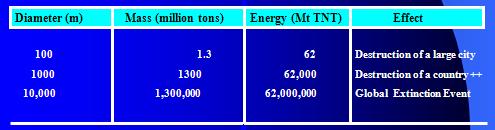
Crater sizes from hypervelocity impacts may be determined by comparison with craters produced in nuclear explosions.
The following table indicates the expected crater size for a given NEO diameter:
| NEO Diameter | Crater |
| 10m | Minimum size of iron asteroid for hypervelocity impact |
| 50m | Minimum size of comet for hyper- velocity impact |
| 100m | 1 - 2 km |
| 500m | 4 - 10 km |
| 1 km | 10 - 20 km |
| 5km | 40 - 100 km |
| 10km | 100 - 200 km |
PLANETARY DEFENCE - PHASE 2
ACKNOWLEDGEMENT AND AWARENESS
The second phase of Planetary Defence is one of surveillance, detection, tracking and extrapolation. It is one where we:
We can achieve this goal by:
> Astrometry - measuring positions of NEOs
> Photometry - determining brightness
> Morphology and Composition - specialised observations
> Orbit Analysis - impact hazard
An image is obtained using a CCD camera attached to a telescope. Typical exposure times may be from 10 seconds to 5 minutes.
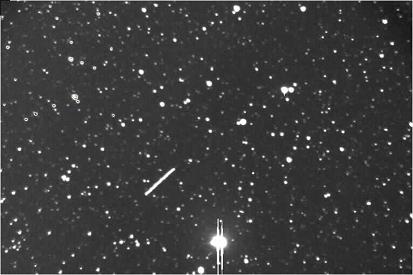
The position of the asteroid is determined by comparison with the accurately known positions of other stars in the field of view.
Several computer programs are available to automate this process. Accuracies less than 1 arc-second are achievable with good images.
As with astrometry, the brightness of an asteroid is determined by comparison with the known brightness of a comparison star or stars.
A CCD camera is a very linear device, and the number of electrons collected is a given fraction of the number of photons incident on each pixel.
A spectroscope may be attached to the back of a telescope to provide a spectrum of the light from the asteroid. If this is done in the infrared it can provide details about the surface composition of the body. This requires the telescope to be located on a high mountain, above the atmosphere that absorbs near infrared light. Far infrared imaging requires a telescope in space.
Observations are reported to the Minor Planet Center who will then compute an orbit. Information reported includes UT (Universal Time) to the nearest second, right ascension to 0.01 second, declination to 0.1 arcsecond and photometric brightness to 0.1 magnitude.
Orbital analysis for impact hazard evaluation in carried out by JPL in the USA and by Neodys (University of Piza) in Italy.
HAZARD SCALES
Two hazard scales for potential impactors have been developed. The first, a public scale called the Torino scale was developed by Richard Binzel of MIT. It is based on the kinetic energy of the impactor and its collision probability.
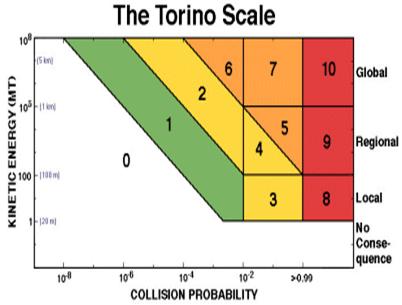
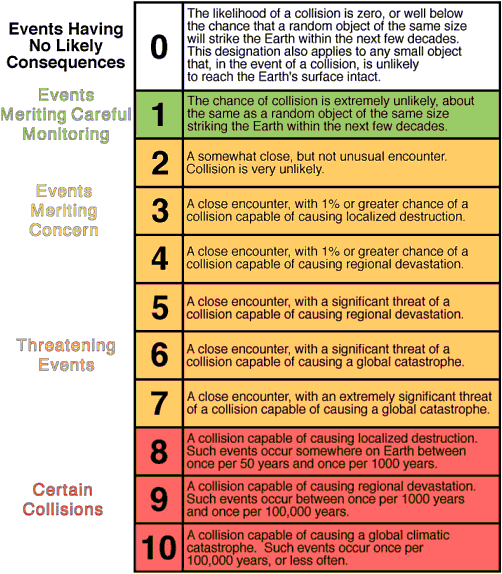
The second scale is a technical scale called the Palermo scale where values above zero are significant. It is the base-10 logarithm of the relative risk:
The cumulative Palermo Scale value reflects the seriousness of the entirety of detected potential collision solutions. It is the base-10 logarithm of the sum of the individual relative risk values:
THE MAJOR NEO SEARCH PROGRAMS
The first major search programs were Spacewatch, LINEAR, LONEOS, NEAT and CSS.
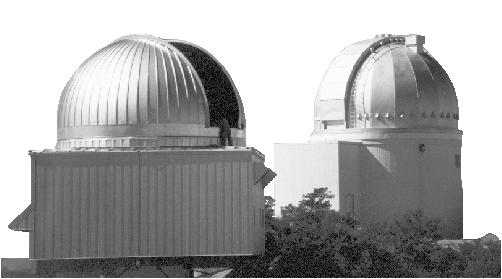
The SPACEWATCH program was the first dedicated NEO search program. It was started by Tom Gehrels of the Lunar and Planetary Laboratory at the University of Arizona. It hosts two telescopes, 09m and 1.8m on Kitt Peak, about 130 km west of Tucson, Arizona.
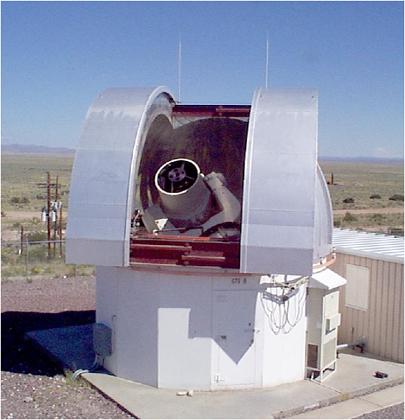
LINEAR is a project of the MIT Lincoln Laboratory run by Grant Stokes. It is based on the USAF GEODSS (a satellite observational system) and hosts two 1m telescopes surplus to the GEODSS requirements. It is located near Socorro, New Mexico.
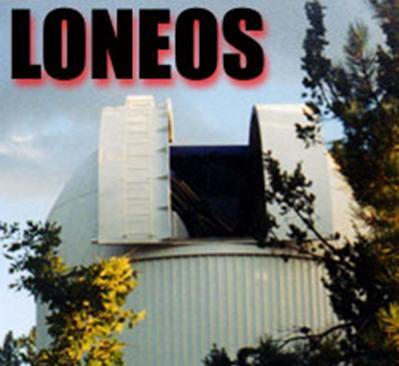
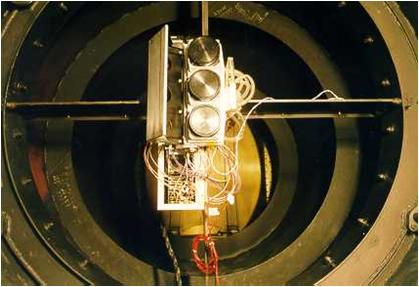
LONEOS is the Lowell Observatory Near-Earth-Object Search project. It started out with 0.6m f/1.8 Schmidt telescope. It recovered the long lost asteroid 1937 UB Hermes.
The NEAT project actually was two programs. NEAT/PALOMAR used a 1.2m Schmidt telescope on Mount Palomar in California. NEAT/MSSS used a similar telescope at the US Air Force Space Surveillance Site on the Hawaiian island of Maui.
The Catalina Sky Survey (CSS) of the Lunar and Planetary Laboratory at the University of Arizona has a number of telescopes:
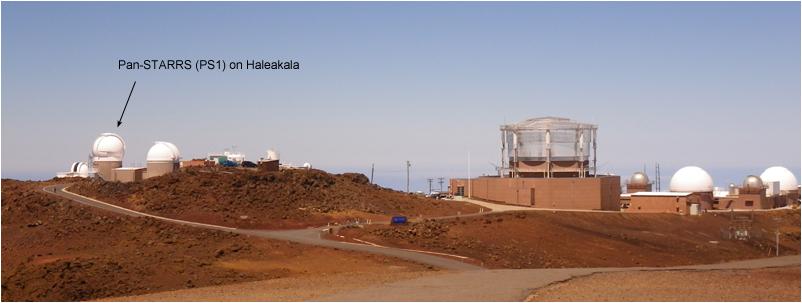
The Pan-STARRS telescope on Haleakala and the NEOWISE spacecraft have more recently made valuable contributions.
In the near future the Large Scale Synoptic Telescope and the Vera Rubin Observatory promise repeated coverage of the night sky every few nights.
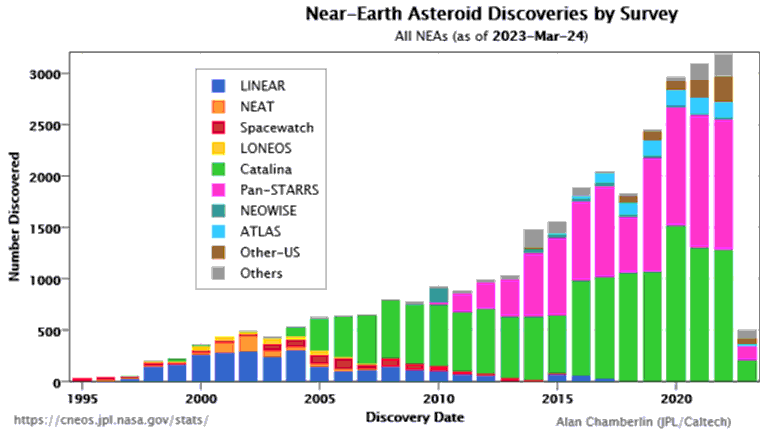
There are many other NEO search programs around the world that use both optical and radar instruments in their search. The discovery rates are shown in the JPL graph below. Note that NEOs (Near Earth Objects) include NEAs (Near Earth Asteroids> and NECs (Near Earth Comets). However NECs << NEAs.
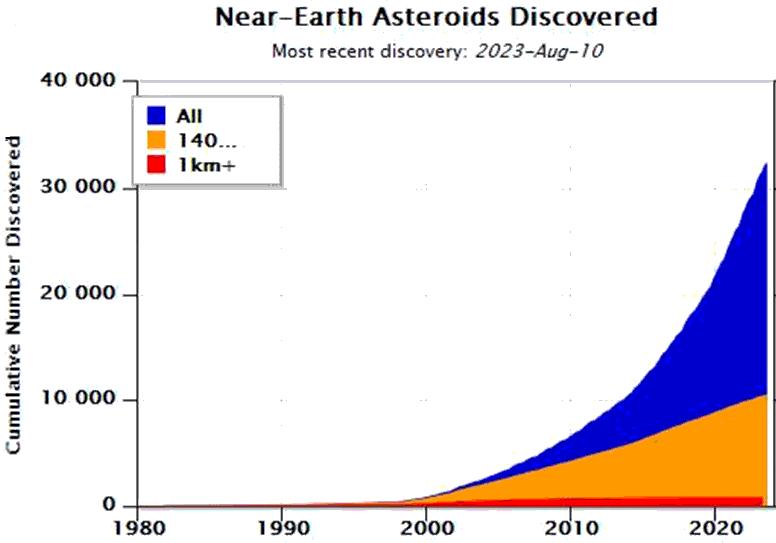
The detection statistics are shown in the second JPL graph below.
INTERNATIONAL ASTEROID WARNING NETWORK
The IAWN is a virtual network of institutions that discover, monitor and characterize near-Earth objects (NEOs) and communicate impact risks. It has more than thirty members from observatories and space institutions worldwide.
IAWN was established in 2013 as a result of the UN-endorsed recommendations for an international response to a potential NEO impact threat, to create an international group of organizations involved in detecting, tracking, and characterizing NEOs. The IAWN is tasked with developing a strategy using well-defined communication plans and protocols to assist Governments in the analysis of asteroid hazards.
It now organises biennial planetary defence conferences at different venues around the world.
IAWN replaces the unofficial 'Spaceguard' organisation.
 |
 |
PHASE 2 SUMMARY
PLANETARY DEFENCE - PHASE 3
AVERSION OF THE IMPACT HAZARD
Phase 3 of Planetary Defence involves mitigation, interception and deflection. This last phase of planetary defence is the most controversial.
| Many ideas have been proposed. Some involve giving an asteroid a gentle nudge over a period of time - either with rocket propulsion or using reaction mass from the NEO itself. Others involve giving the asteroid a large single impulse. All schemes require a substantial warning time to allow the relatively small total push to translate to a significant path deflection. | 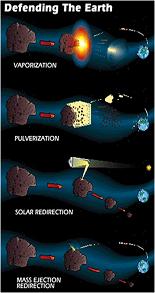 |
As an historical aside we should mention that over fifty years ago in 1953 Allan Kelly and Frank Dachille published a book called “Target Earth” in which they which they foresaw the need for a system to survey ‘a critical envelope of space’ to detect objects that might be on a collision course with Earth, and that if such an object was detected ‘to this end might be used rocket “tug boats” sent out to deflect and guide the object from the collision course’.
Some of the ways in which asteroid deflection might be achieved are:
| A rocket with an ion engine is carefully maneuvered into position against the asteroid, and the engines deliver a very small force for several months. This will cause a very small change in the velocity of the NEO. | 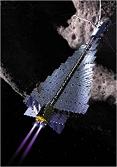 |
| A nuclear explosion is activated above the target surface - to avoid breaking up the asteroid. his produces a small change in the velocity of the NEO. | 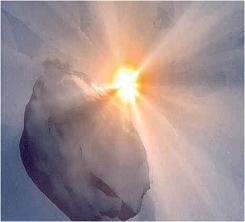 |
| Attach a very large solar sail to the NEO to change its velocity vector. | 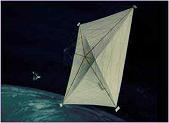 |
| Use a solar collector to heat the NEO material causing vapour to be ejected and the mass reaction (rocket) principle to change the NEO velocity | 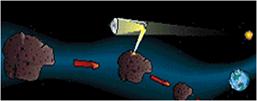 |
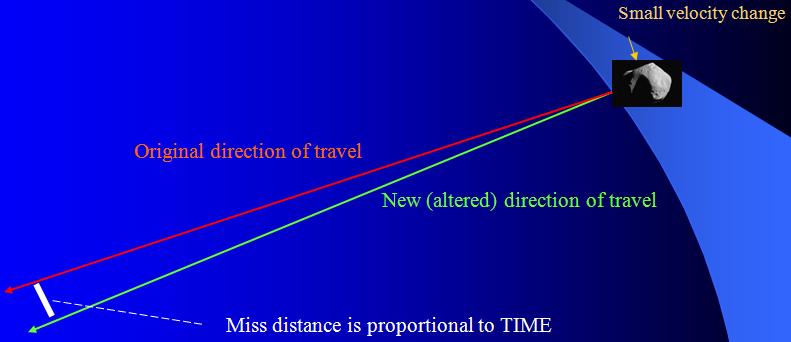
All methods require a long time for the small velocity change to translate into a significant orbit change so that the potential impactor is diverted by an adequate margin to miss the Earth. Possibly several years.
| A velocity change converts time into distance |
The problems with all methods are:
THE DART MISSION
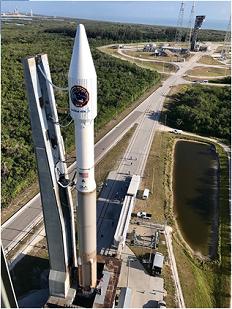
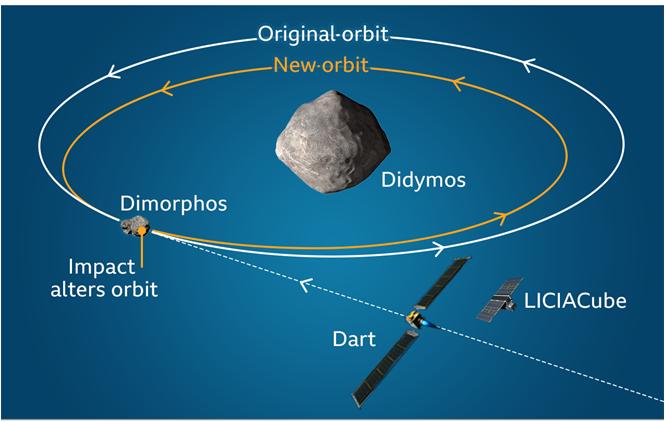
A NASA mission called DART has now successfully deflected the asteroid Dimorphos in orbit around another asteroid called Didymos.
The DART spacecraft was launched on 22 July 2021 and made impact with its target on 7 October 2022. A cubesat called LICIA was released by DART 14 days before impart to observe the changes.
THE APOPHIS EVENT
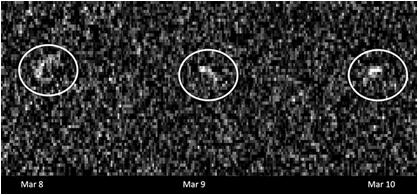
In 2004 a new asteroid was discovered by Roy Tucker, David Tholen and Fabrizio Bernadi. It was initially given the designation 2004 MN4 and then numbered as asteroid 99942. Soon after its discovery it was identified as the most hazardous asteroid with a possible collision with Earth in the year 2029.
It was then given the name APOPHIS by virtue of its potential as a death star. (Apophis was the name of an ancient Egyptian snake god of darkness and disorder)
It has an estimated size of 340 metres. At this size, if it did collide with the Earth it would devastate large parts of the globe. Current predictions have it missing Earth's surface by 32,000 kilometres.
REFERENCES
Duncan Steel, Rogue Asteroids and Doomsday Comets (1995)
Duncan Steel, Target Earth (2000)
M Belton, T Morgan, N Samarasinha & Yeomans (Editors), Mitigation of Hazardous Comets and Asteroids (2004)
Donald K Yeomans, Near-Earth Objects - Finding Them Before They Find Us (2013)
Nikola Schmidt (Editor), Planetary Defence (2019)
Irmgard Marboe (Editor), Legal Aspects of Planetary Defence (2021)
 Australian Space Academy