INTRODUCTION
A small body in space, such as a planetoid/asteroid may have an irregular shape. This is because the internal forces (chemical in nature) in the materials such as rocks of which it is composed are able to maintain their shape. However, in a larger body, such as a planet, the force of gravity becomes large enough to overcome these material forces and produce a spherical shape. In essence gravity induces a fluid like behaviour in the planet and a spherical shape is adopted because it is the shape of lowest energy.
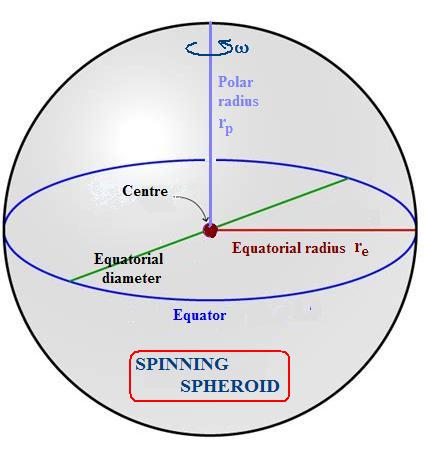
The only exception is when the planet is spinning or rotating. In this case the centrifugal force produced by the rotation causes the planet to adopt the shape of an oblate spheroid where the oblateness is related to the angular spin of the planet. In such a case, the diameter (and thus the radius) along the polar axis (about which the planet is spinning) is smaller that the equatorial axis.
The oblateness ε is defined by the expression:
where re is the equatorial radius and
CALCULATING OBLATENESS
The potential V in a force field is computed from the expression:
where F is the force acting on a small mass m at the point in the field where we wish to compute the potential.
In a gravitational field around a large body of mass M the gravitational force is:
where G is the Universal gravitational constant and
This is only strictly true as long as the oblateness of the mass M is very small.
Substituting this force into the potential equation and integrating we have:
Vp = - G M / rp
However, the equatorial potential is that due only to the mass of the body/planet. There is also a term due to the centrifugal force Fc = - m r ω2 and that is negative because it is in the opposite direction to the gravitational force (ie Fc is away from the center of the mass). This gives rise to a equatorial potential of:
For equilibrium the polar and equatorial potentials must be equal. And so we must have:
This can be solved to give:
where r ≈ re ≈ rp
If we then substitute M = ρ * Volume, where ρ is the object density, then M = 4 ρ π r3 / 3 and this gives:
which is the desired expression for the oblateness of a rotating body.
MEASURED OBLATENESS
The table below gives measured and calculated values of oblateness for the eight major planets as well as their rotation periods and mean density.
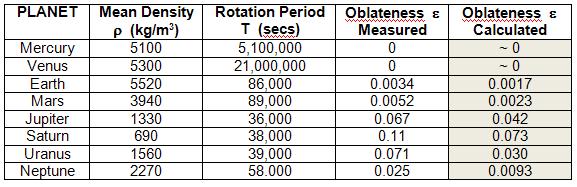
It will be noted that the calculated oblateness is typically about half of the measured value! So what is wrong?
DISCUSSION
The problem is that in the above calculations we assumed that the density of the planet was constant throughout its volume. That is, we used an average density, when in fact the density of a planet's interior shows a very substantial variation with radius, such as is shown for the Earth in the diagram below.
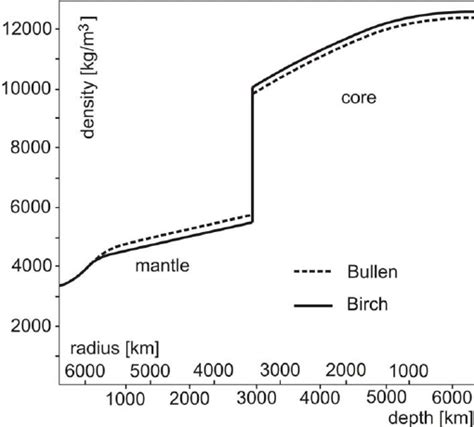
Note that not only does the density vary over a factor of almost 4 but that the variation is discontinuous and thus cannot be represented by a smooth mathematical function. This means that any integration must be carried out numerically and will result in a value, not a formula.
The initial integration V = ∫ ( F / m ) dr - which assumed a constant density essentially just multiplied the force at the planet radius by the radius. This must be replaced by the integral of a spherical shell with a mass dependent upon the density as function of radius. This is shown in the diagram below:
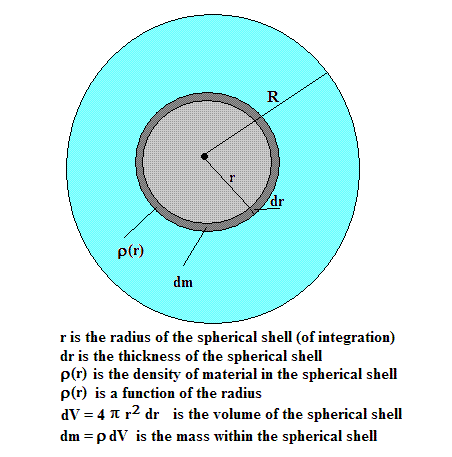
The integral then becomes:
where M(r) = ρ(r) dV = 4 ρ(r) π r2 dr
A simpler approach might be to use the expression
where a value of ρ called the effective, rather than the average, density of the body is used. For the Earth the effective density would be twice the average density (refer to the above table).
Using a range of different density curves the more complex integral would be used to compute an effective density for each density model. The effective density which gave the best match to the actual oblateness would then be the 'correct' model of density variation within the planet. Of course this assumes that only one model will give the correct oblateness, and this will probably not be the case.
However, this illustrates one process by which planetologists might try to evaluate interior models for planets - models which are then refined by spacecraft orbits perturbed in planetary flybys.
 Australian Space Academy