|
THE SUN |
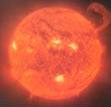
The Sun does not spin or rotate as a solid body. The equator rotates faster than do the polar regions. Different layers inside the Sun also rotate at different rates than the layers immediately above them. This differential rotation is of course only possible because the Sun is a gaseous body (a big ball of gas). Even with the very high estimated pressures at the solar core, the central temperature is high enough to keep the matter in a gaseous state.
Models and measurements from helioseismology lead us to believe that the Sun is divided internally into 3 different regions. The core (about 20% of the solar diameter) is where the nuclear fusion reactions occur that power the Sun. The radiative zone extends from the core out to a radius of about 70% of the Sun. This region is so dense that we believe it can take up to one million years for the particles of heat and light (photons) generated in the core to work their way through it. The outer 30% of the solar diameter is the convection zone where motions are very turbulent. The top of this zone is the photosphere.
The Sun has a constantly changing magnetic field, which is to believed to be generated at the base of the convection zone by the motions there. This magnetic field, twisted by the differential rotation of the Sun, is believed to produce sunspots on the solar surface together with solar activity such as flares and coronal mass ejections that can be observed with special filters.
The solar atmosphere is divided into a lower atmosphere (the chromosphere) and the outer atmosphere (the corona). The corona extends out through the solar system as what we term the solar wind. The coronal temperature near the Sun is about 2 million degrees (K).
APPROXIMATE SOLAR PARAMETERS
Diameter = 1,400,000 km ( = 109 times the Earth's diameter )
Mass = 2 x 1030 kg ( 330,000 Earth masses )
Volume = 1.4 x 1027 m3 ( 1.3 million times Earth's volume)
Average density = 1400 kg m-3 ( 1.4 times the density of water)
Surface gravity = 270 m s-2 ( 27 x Earth's gravity )
Surface temperature = 6,000 K
Surface pressure = 1 kPa ( 1/100 Earth's sea level pressure of 101 kPa)
Core temperature = 15 million K ( estimated from models )
Core pressure = 2.3 x 10¹³ kPa
Core density = 150,000 kg m-3
Average rotation rate = once every 27 days ( varies with latitude )
Luminosity = 3.8 x 1026 W
Fuel consumption = 5 millions tons of hydrogen per second
Fuel cycle - nuclear fusion ( 4 H atoms fuse to form a He atom )
Sunspot cycle period = 11 years
Age = 5,000 million years ( estimated from models )
 |
MERCURY |
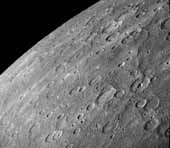
The surface of Mercury is covered by craters, and one large impact feature, named Caloris, is spread over 1300 km and has 'weird' terrain at its antipodal point. Of the four terrestrial planets (Mercury, Venus, Earth and Mars), only Mercury and the Earth have a global magnetic field.
ORBITAL PARAMETERS FOR MERCURY
Mean distance from the Sun = 57.9 million km (0.387 AU)
Orbital eccentricity = 0.206
Orbital inclination to the ecliptic = 7.01 degrees
Orbital period = 87.969 days
Mean orbital velocity = 47.9 km/sec
Advance in perihelion = 10 minutes of arc per century
PLANETARY PARAMETERS
Mass = 3.30 x 10²³ kg
Mean radius = 2438 km
Mean density = 5430 kg/m3
Gravity = 3.7 m/sec2 = 0.38 g (g = Earth gravity)
Escape velocity = 4.25 km/sec
Synodic rotation period (mean) = 115.9 days
Sidereal rotation period = 58.6 days (= 2/3 of orbital period)
Surface temperature range = 100 - 700 K
Inclination of equator to orbit = 1o (approx)
Mean solar constant = 9940 W/m2
 |
VENUS |
ORBITAL PARAMETERS FOR VENUS
Mean distance from the Sun = 108.2 million km (0.723 AU)
Orbital eccentricity = 0.007
Orbital inclination to the ecliptic = 3.39 degrees
Orbital period = 224.70 days
Mean orbital velocity = 35.0 km/sec
PLANETARY PARAMETERS
Mass = 4.87 x 1024 kg
Mean radius = 6052 km
Mean density = 5243 kg/m3
Gravity = 8.9 m/sec2 = 0.91 g (g = Earth gravity)
Escape velocity = 10.4 km/sec
Synodic rotation period (mean) = 116.8 days
Sidereal rotation period = 243.0 days (retrograde)
Surface temperature range = 650 - 750 K (estimates)
Inclination of equator to orbit = 177o
Mean solar constant = 2614 W/m2
Surface atmospheric pressure = 9,200 kPa
Surface atmospheric density = 65 kg/m3
 |
EARTH |
ORBITAL PARAMETERS FOR EARTH
Mean distance from the Sun = 149.6 million km (1.000 AU)
Orbital eccentricity = 0.017
Orbital inclination to the ecliptic = 0.00 degrees
Orbital period = 365.26 days
Mean orbital velocity = 29.8 km/sec
PLANETARY PARAMETERS
Mass = 5.97 x 1024 kg
Mean radius = 6371 km
Mean density = 5515 kg/m3
Gravity = 9.8 m/sec2 = 1.00 g (g = Earth gravity)
Escape velocity = 11.2 km/sec
Synodic rotation period (mean) = 24.00 hours
Sidereal rotation period = 23.935 hours
Surface temperature range = 180 - 330 K
Inclination of equator to orbit = 23.45o (approx)
Mean solar constant = 1376 W/m2
Surface atmospheric pressure = 101 kPa
Surface atmospheric density = 1.23 kg/m3
 |
MARS |
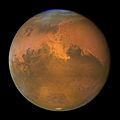
ORBITAL PARAMETERS FOR MARS
Mean distance from the Sun = 227.9 million km (1.52 AU)
Orbital eccentricity = 0.093
Orbital inclination to the ecliptic = 1.85 degrees
Orbital period = 686.98 days
Mean orbital velocity = 24.1 km/sec
PLANETARY PARAMETERS
Mass = 6.42 x 10²³ kg
Mean radius = 3389 km
Mean density = 3933 kg/m3
Gravity = 3.7 m/sec2 = 0.38 g (g = Earth gravity)
Escape velocity = 5.0 km/sec
Synodic rotation period (mean) = 24.66 hours
Sidereal rotation period = 24.62 hours
Surface temperature range = 140 - 300 K
Inclination of equator to orbit = 25.19o (approx)
Mean solar constant = 589 W/m2
Surface atmospheric pressure = 0.6 kPa
Surface atmospheric density = 0.016 kg/m3